

Since becoming a mom, my relationship to religion has undergone change. I grew up Christian-not evangelical or in toxic religion, but I have deconstructed a lot of it. I still consider Christianity my home, but my practice of it is in flux. I seek a way that is more vulnerable, more loving, more contemplative than what we generally associate with American Christianity Inc. With my own young children I hope to keep that sense of wonder and awe present for them in their religious upbringing-prioritizing mystery over certainty and love over doctrine. Here are a few practical steps I take to plant those seeds for the future.
1. Praise the Effort
I know it might not seem related – that a growth mindset is related to spiritual awareness, but it absolutely is. We are all in process, and that process is messy, beautiful, and important. It’s part of what makes us into the people we become! A fixed mindset, in contrast, tells us we are either good or bad and undermines grace and belovedness. It says, ‘you have a finite amount of talent for art or music or writing or _____ and you are either enough or not.’ In a fixed mindset, when we fail, we internalize that as shame for not being better. It’s proof that we aren’t enough and never can be. But failure is how we learn, and if we are too afraid to fail for fear of it confirming our lack of ability, we will have no ability. It’s a self-fulfilling prophesy that cuts us off from parts of ourselves and meaningful engagement with the world. Worse than all that, if our children think they could ever not be enough for us, then they’ll never step out into their own beliefs, exploring, stretching, and making their relationship with God/Divine their own. If we’re too afraid to risk newness because we could fail, and if we fail we won’t be loveable, we won’t learn or do anything new. Making an imperfect effort is the first step in living more contemplatively, because without that start, we won’t ever get anywhere.
My tradition is Christianity, and in it God first creates the world, looks upon it, and then declares it good. I view this as an artistic imperative: we can’t start out saying “I’m going to make something GOOD.” There is always a possibility of failure (now, maybe you’d argue that isn’t so with God or the Divine, that’s fine! But I like to imagine God’s solidarity with us). When I start out by saying, I have to make this good, I’ve already lost. I close up, I can’t draw or play or write, and I inevitably am disappointed with whatever I produced, regardless of its actual value. My judgment entirely swallows up my creation, and I spend the rest of the time in the middle of my shame gremlins. Shame has no place in contemplative parenting. So let’s do all we can do cultivate a growth mindset for ourselves and our children.
2. Walk in Nature
The Natural world is the first revelation of God, with complements to Franciscan Friar Richard Rohr for transmitting this teaching to me. Others have said it too, but to track more of that down, you can go to Rohr directly. The story of Genesis, the mythical creation of the world, says it was good, it was good it was good! God played, and danced, and worked, and it was good! God poured out Godself into creation, and we are all made in God’s image. Spending time in nature pulls us out of our devices and distractions and reminds us of our littleness. But in nature there’s also the constant reminder of belovedness for the little things: flowers, butterflies, and chipmunks. We who are charged with the care and loving of little people would do well to be reminded of our littleness, too. Just as God acts in solidarity with us, we can mirror that by acting in solidarity with our children.
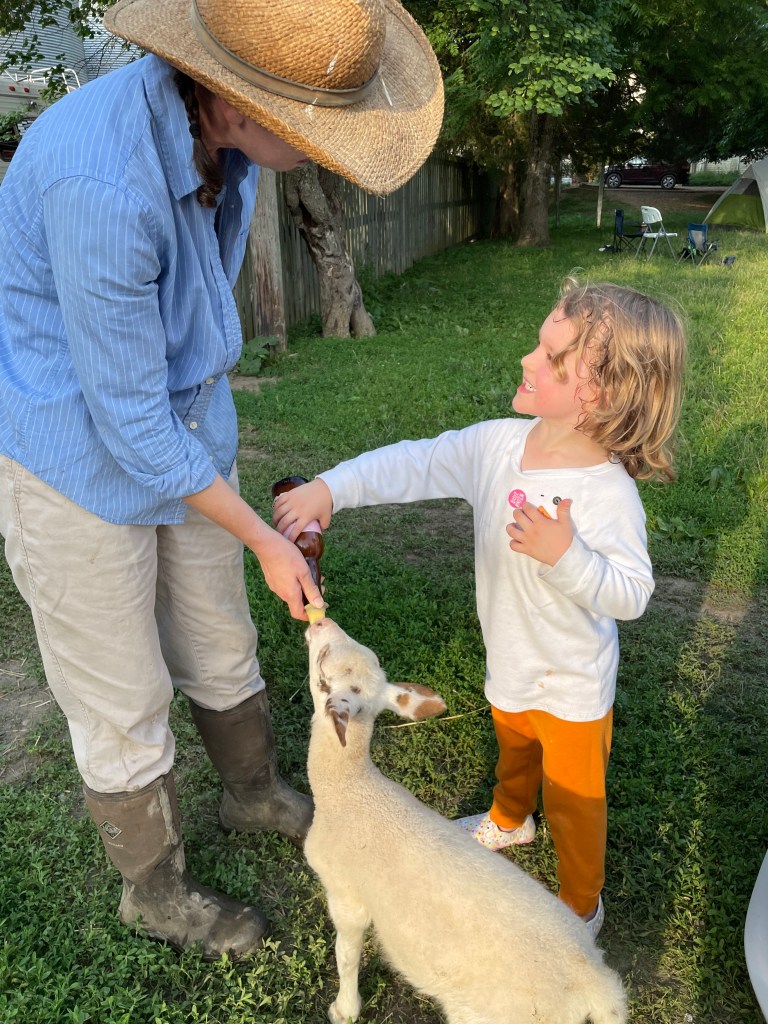
Moreover, going out in nature is an opportunity to talk and listen. Strong, loving relationships aren’t built from a few big interactions, but from the regular tending to growth, mutuality, and support. Making nature a regular part of your ‘special time together’ also makes space for the deeper conversations. When we go hiking, we’re always on the lookout for ‘magic leaves’, that is, a leaf hanging by a spider thread. That’s the level of ‘deep conversation’ we cultivated with our young toddler, but he’s older now and we still look for magic leaves. Maybe those deeper conversations are about Minecraft. Or Gabby Cats. That’s ok! Entering into what’s important to your kid is an act of love, and that’s what we’re trying to model. Wondering together in nature, even if it isn’t directly about the nature in front of you, is still wonder, and still a contemplative practice.
3. Read Books that Wonder
I honestly have trouble with lots of religious books for children. The whiteness, the masculine language, the sanitized Bible stories like David and Goliath or Noah’s Ark 😳. It’s low-key grooming kids to accept a domination model of religion, which is exactly what I want to avoid. I want to devote a blog post solely to great books for spiritual awareness raising in children, so for now I want to focus on a few reflection questions for choosing media for kids.
First, look at the pictures. If every illustration is of white people, I am not interested. Though sometimes it’s not so clear what the representation of people is actually saying. A popular older series of Bible stories for little kids came my way. The Old Testament story characters and the New Testament story characters are different skin tones. As in, the OT characters are darker, and the people in the NT stories are lighter… To me, this seems like an example of goodness as proximity to whiteness. I think the original hope was to make the intended audience see themselves in the characters surrounding Jesus? That’s problematic! It suggests a certain desire to reject or ignore all of history since Christ and naively see oneself as following Christ.. in the context of a complex and unexamined American imperialist culture. So first look at the representation in the book, because that will be the child’s main entry into the book, too.
Second, what language is used? Most books I’ve encountered use exclusively masculine pronouns for God. This isn’t a dealbreaker since I can always switch up pronouns and I’m not opposed to masculine pronouns for God. That can be an important devotional aspect for some people. But we’re kidding ourselves if we think everyone can and should have a positive relationship with their father and therefore “God the Father.” And we’re limiting our imaginations if we think only masculine pronouns are appropriate. There are other aspects of a book’s language to examine as well. Are there question marks in the book, or is it mostly statements? Awe and wonder aren’t fostered by certainty, so books that open the space for questions are going to do a better job of looking at the stories contemplatively. Again, I can ask these questions myself, but having other points of view helps! I can’t possibly think of every avenue for exploration. Questions are an important way to invite wonder into your faith talks.
Last, consider some good aspects of your faith and messages that you want to share. I love this little board book for babies, it’s a psalm movement primer. Different movements inspired by psalm verses each get a page. It’s devotional and beautifully illustrated. I love that it’s embodied-literally teaching faith through movement (see #4 below!). It works with the natural state of little kids (which I think is just constant movement) and relates to them in a beautiful way. The tougher Bible stories, like King David’s (mis)adventures, Noah, and King Herod are all worth teaching to kids, but we have got to do better in presenting them. I think we do a huge disservice to young children in teaching without nuance, even while the nuance is not something young children can entirely grasp. Maybe your kid is like mine and will listen to you half-rant half-ramble about the necessary nuances. I really don’t know what he gets from it, to be honest! Maybe it’s better to avoid those stories for now. I sort of follow a combination of those strategies, so I don’t think there’s any perfect answer here. I’m in process on this, and giving myself the grace for that to be enough! We invite our children into awe when we can hold the challenge of the stories with the unfailing love and devotion of God to God’s people. We invite wonder when we invite our children to reconcile seemingly contradictory ideas, and not to have to have all the answers.
4. Dance together
Really! I mean it! Maybe not every kid likes dancing, but I haven’t met a toddler yet who doesn’t love to dance. I think we train them out of it more than kids are born not enjoying dance and creative movement. The first time I saw Theo dance he was 11 months old and I was singing to myself. Suddenly, he was watching me sing and twisting back and forth. It was beautiful and adorable. Ever since then we’ve made a point to dance together. And we dance very badly, so we laugh all the more. I think the laughter and connection are so important because it fosters as stronger bond!
Additionally, getting into your body reminds you not to forsake it. Dancing is a great way to connect to your own body, but it’s not the only way. Our bodies, like the rest of creation, were made good, but our culture sends message after message that they’re too big, too oily, too exposed, not exposed enough. So reclaim your body from the outsider gaze and dance in whatever way your kid shows you. They’re the teacher in this area.
5. Listen for God’s Presence
Although it seemed like it morphed into a delay tactic at night, some of my favorite conversations with my son were from asking him if he felt God’s presence that day. I started it in response to reading a book I’ve mentioned before-Spiritual Conversations with Children by Lacy Finn Borgo. It stirred up in me a desire to be more proactive in noticing together the Spirit at play during our day. What I got from it was mostly an awareness of how close I felt to the Divine when I was around Theo, my son. What he got from it, I’m not sure, but he did say some profound things. One time we were driving in the car and I asked him, ‘Do you feel God saying anything to you?’ And he replied, ‘yes! God says “I am hungry!”‘ I unfortunately didn’t catch this until discussing it with my Spiritual Director some time later; hunger for God is a big theme in the Bible! And God’s hunger for us is also a major theme. Instead, I assumed that he was just noticing his tummy. Maybe he mistook it for God. Maybe the two were united in that moment! Maybe he wasn’t physically hungry but aware of a deeper yearning for God and presence. I don’t know. But I know that, even though the time period of us having those conversations was somewhat brief, the seed was planted. I trust it to grow how it’s meant to, even though Theo deflects from this question now.
God says: “I am hungry!”
-three Year Old Theo
Although I do not claim any sort of authority, it seems obvious to me that if we want to raise children in an inclusive, welcoming, spiritual environment, we need to start with ourselves and lead through our parenting philosophy. Managing our emotions, reactions, and expectations in positive ways sets us up for a greater sense of peace, which invites others in as well. I cannot fake my way through relational harmony-no one can! When we do, we low-key gaslight those around us who sense things aren’t quite right. With children, they don’t have the words to understand our discomfort yet, and internalize the disconnect. And that’s counterproductive.
Gentle parenting is definitely a buzz word and may engender a certain image for you, so let me assure you I do believe in consequences and discipline! I don’t believe in passing on a domination system mentality by cultivating it at home. I don’t believe in belittling, berating, or otherwise discounting the lived experiences of my kids, even when we’re late out the door or stressed or otherwise disregulated. I have a LOT of growing still to do-I still yell and make mistakes with my kids. But I repair afterwards, as Dr. Becky Kennedy shows us is what’s most important. I’m learning to be more inquisitive when behaviors happen and less reactive, and that’s a win for ALL of us. I need that safe space when I’m feeling upset, too!
Ultimately, these steps are as much for ME as they may have been for my kid, now kids. And that’s ok! The myth of (Western) individuality would tell us we are all separate, but that just isn’t true. Even in seeking to show my children a contemplative path, I myself am gaining greater insight into my own path. Ultimately, this is about raising kind, empathetic, confident, and loving humans. And that goes for us, too.

 Actually an Artist
Leave a comment