
Today is Good Friday in the Western Christian world. Last night, I dreamt of being caught in a mass shooting. In the contemporary show, “Star Trek: Strange New Worlds,” episode 6, season 1, the Enterprise crew encounters the utopian society of Majalas. Their society is in transition with a new First Servant returning from his years long preparation to ascend to his role. This episode seems to be based on a work of science fiction by Ursula K. Le Guin, “The Ones Who Walk Away from Omelas,” although I am not familiar with this work, I did want to give proper credit to the basis for this episode.
I found this episode very compelling for this day and age: we have made great scientific, artistic, and cultural advancements, but we not only allow for, but require the suffering of children to maintain this façade. At least in Majalas or Omelas, the allegorical utopias in these stories, only one child is suffering. Isn’t that better, the story implies. If only one person suffers, despite it being a great suffering, that’s surely better than everyone suffering, even if it’s not as much.
While I don’t think that’s the moral quandary in the Passion of Jesus, atonement theology, or the assertion that Jesus had to die for our sins, does make that argument. In the church I served before leaving, Jesus came to ‘wash us white as snow’ and ‘free from our sins’, rather simplistic language and strongly aligned with the idea that one person could take on the whole of a society’s suffering. Everything left over is literally whitewashed, made to look better, with even less room for the difficult questions and weight of moral responsibility. Atonement theology says that I’m bad and God made Jesus die so I won’t have to. It doesn’t call for change or reform. It prepares the First Servant generation after generation for a life made for suffering.



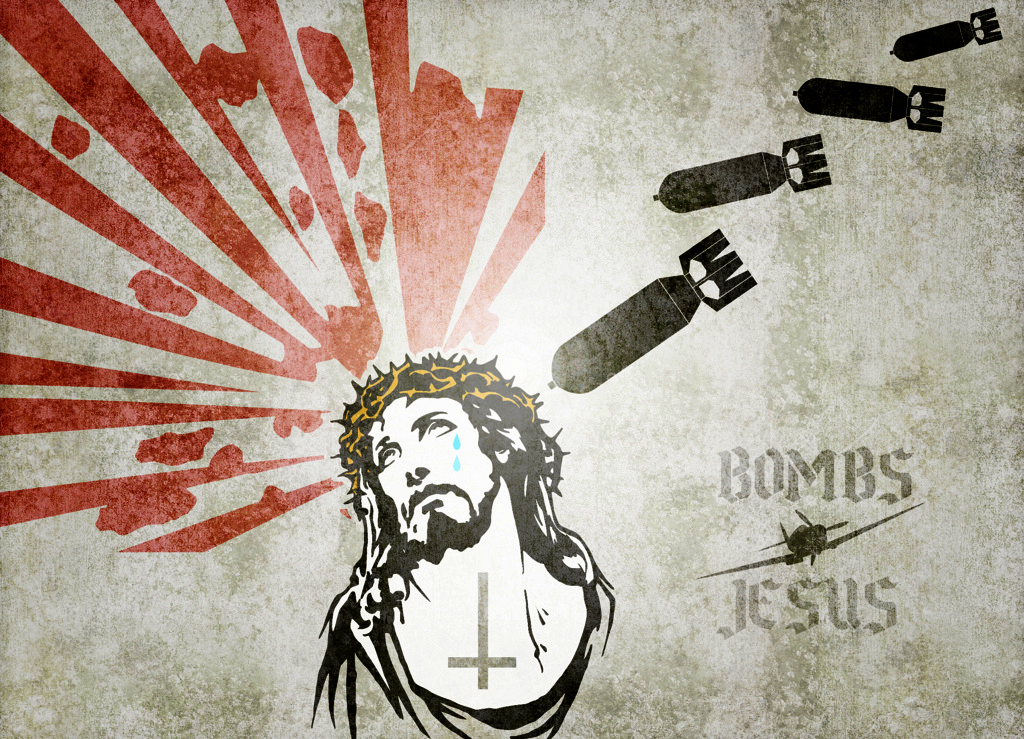

Where I am now is attending a church because I want to be there. In fact, I just got home from the Good Friday service with these ideas fresh in my mind. The overarching message was that humanity has continually sacrificed Jesus to avoid looking at ourselves. We handed Jesus over and demanded a bandit be released because he asked the hard questions, challenged our way of life, and refused to play by the social order of things: these people are good and to be emulated, those people are untouchable, deserving of their suffering. And because we chose this death, we can also choose differently. We can walk away from Omelas and keep our morality intact.
I feel so powerless against a whole government, a whole society, that has decided the periodic deaths of children and their adults is necessary for the continuation of the life we live. Whether its the tens of thousands of children killed or maimed in the Gaza strip, or the thousands of children shot every year in the United States, it’s clear we’ve decided change is too difficult to prevent the suffering of a child.1 We have accepted the façade, refused the truth of Majalas, and made a God in our image to justify our inaction. The mystical truth of Jesus’s life, death, and resurrection may be too far distant to motivate us to change, but the damnation of our way of life is clear for anyone with eyes to see. It doesn’t just damn us who lose someone. It damns us who love someone we fear losing. We don’t have to chant Crucify Him with the crowd. We don’t have to keep choosing this society.
- See https://www.bradyunited.org/key-statistics for the full statistics on gun violence in America. ↩︎
 Actually an Artist
Leave a comment